
Artificial Intelligence is the Manhattan Project of Human Autonomy
AI can become the political tyranny of the mind

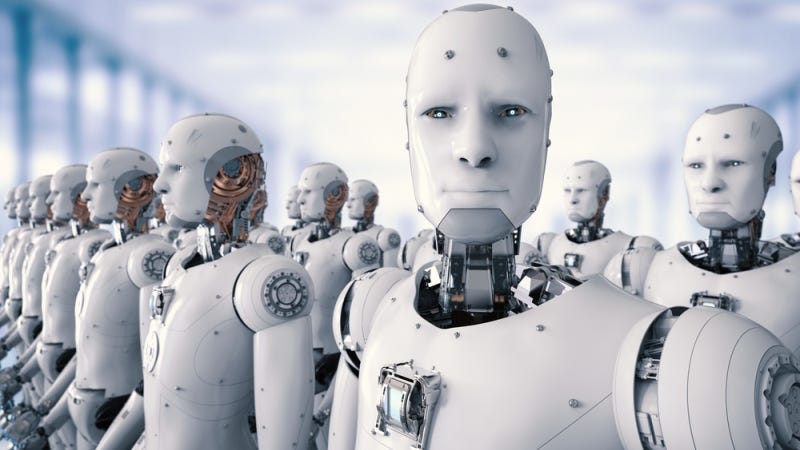
The ACLU has called AI a “recipe for tyranny.” And do note all these robots are white.
When the comedian and Daily Show host Ronny Chieng told Harvard graduates to “kill AI,” he wasn’t joking.
His serious purpose was to defend critical thinking and creativity.
“Whatever your chosen profession is, please don’t let AI rob you of the fun part of it,” he told the senior class. “Our generation’s upcoming battle…is going to be people with substance versus people with shallow knowledge, it’s going to be mastery versus faking it, it’s going to be people with good taste versus tacky. I trust you will put in the work necessary to be on the right side of those battles.”
I am thinking about writing a new mystery novel called “Artificial Ignorance.” (I’m not sure I’m going to do that yet, but stay tuned. I have drafted a first chapter.)
My first line in the new novel is “Artificial Intelligence is the Manhattan Project of human autonomy.”
The Manhattan Project, as I’m sure you know, refers to the overarching weapons-production program begun in late 1942. It resulted in nuclear chain reactions that created bombs of astonishing destructive power.
From the “Shuddering Dawn” of the first successful test of a nuclear weapon, the human capacity to split the atom and release its incredible power has often been imaged as grasping the power that should belong only to God, the power over all life and death. “I am become death, the shatterer of worlds,” quoted J. Robert Oppenheimer, director of the Los Alamos laboratory that developed nuclear weapons, upon seeing the destruction wrought by the first nuclear weapon. Oppenheimer was citing from the Hindu epic, the Bhagavad Gita.
Winston Churchill called the bomb “the Second Coming in Wrath.” Christian fundamentalists such as Hal Lindsey, Pat Robertson and John Wesley White specifically identified the bomb with God’s judgment and world- destroying nuclear war with the salvation of the righteous. You can practically see them drooling over the destruction of their chosen sinners.
Nuclear guilt is inaccurately portrayed in the film Oppenheimer, but there was guilt especially when it was theoretically possible, however small a risk, for the blast to ignite surface hydrogen and actually destroy the world.
Pope Leo has written an important encyclical on AI and human dignity entitled Magnifica Humanitas.
The Pope defends human dignity against the onslaught of rapacious capitalism. He exposes the “invisible hand” of the market as a grasping, valueless pursuit of profit.
Yes, that’s crucial.
But what Chieng grasps is that the creativity of the human mind is at stake as this technology that summarizes your email or writes your memo, or edits your book chapter down to pablum.
Will AI write the “great American novel” that you have the capacity to write but you don’t because AI keeps intruding from the side of the screen?
Imagine AI scanning Beloved, the Pulitzer Prize-winning novel by Toni Morrison about the destructive legacy of slavery.
The story, inspired by the true story of Margaret Garner, uses a non-linear structure to explore trauma, memory, and the struggle for freedom, with the arrival of a mysterious young woman named Beloved forcing the characters to confront their past.
AI is deeply, profoundly racist as it culls from what has already been written. More and more researchers are finding that Large Language Models perpetuate covert racism to a previously unrecognized extent.
Of course they do.
To think outside the mental prison of racism, of sexism, of homophobia and other constraints, what I am calling the “tyranny over the mind,” you have to move beyond what has gone before to what can challenge and change.
For that you need human creativity. And courage.